Monday, May 17, 2010

"Ultimately, this situation can only be resolved by negotiation"

You gotta love the UN.

As a fifth wheel, they serve a purpose. If not for the world, then at least for themselves. Bear in mind the following:

- There are over 22 specialist UN agencies.
- There are over 51,000 staff directly employed (not including the World Bank or long/short term consultants) by UN agencies.
- There are 46 Under-Secretary-Generals (or quivalent rank/seniority). USGs have diplomatic rank equivalent to that of a national cabinet minister. No other government anywhere in the world has that many cabinet ministers for its functioning. The figure of 46 is not exhaustive and there are more USGs or their equivalent - the UN just doesn't have a list of them all that is accessible in the public domain.

So, someone on behalf of the UN (which is 'One' anyway, except in the case of funding, in which case it's 22+ separate agencies) has urged a negotiated solution because "there is a high risk that the situation could spiral out of control".

It's like someone on a trolley in ICU being prepped for emergency cardiovascular surgery after a heart attack making a call on his mobile; "yeah, I'm having a heart attack, so things aren't looking too good".

UNHCR, always on the highest of steeds, offers the stern and wholly unsolicited advice, "Ultimately, this situation can only be resolved by negotiation".

Hmmm. Yes, the UN has spoken. As one. We should sit up and take notice. Because it's the UN.

What's not interesting about the Red Shirts' ten-week protest?

Military attempts to disperse the protesters on 10 April 2010 and more recently have failed; government figures (probably the most reliable in the circumstances) cite 66 people have died and more than 1,600 have been wounded since the Red Shirts began their protests in March.

The police appear to be defending the protesters against the army.

Diplomats and others have approached the Red Shirts to find out what they want; with no change to their pretty obvious demands; "Elections, NOW, NOW!"

The Red Shirts have even trotted out the oldest of negotiation chestnuts in fragile states where the government is self-appointed; UN mediated talks!

The vast majority of the protesters hail from the North and are amongst the rural poor of Thailand.

Let's just imagine, for a moment, what the UN could offer besides from legitimising the protests and turning them into an international incident (because it's not already, it's NOT!):

"We can help you like we've helped Timor Leste, the Democratic Republic of Congo, Afghanistan, Iraq, Haiti, Aceh, and many other countries. Seriously."

"We have mediators that are taken seriously by all sides, people like Ibrahim Gambari."

The other thing that is so incorrigible about the Red Shirts' protest is the infernal paradox it raises; you can hardly hold an election when the Red Shirts' party affiliates will almost certainly win. Those damned poor farmers in Thailand are really getting in the way with their protesting shennanigans!

Thursday, May 13, 2010

Mental As Anything: Paris Principles

I was checking out one of my favourite sites, Aid Thoughts, and it brought to mind the dreaded Paris Declaration on Aid Effectiveness. This Pandora's Box of turd-flavoured truffles ostensibly defines the responsibility of developed and developing countries for delivering and managing aid along five core principles:

1.Ownership: Partner countries exercise effective leadership over their development policies, and strategies and co-ordinate development actions
2.Alignment: Donors base their overall support on partner countries' national development strategies, institutions and procedures
3.Harmonisation: Donors' actions are more harmonized, transparent and collectively effective
4.Managing for Results: Managing resources and improving decision-making for results
5.Mutual Accountability: Donors and partners are accountable for development results

As with all of these international instruments, it is stupendously garbled and repetitive, but the purpose of this little ruse appears to be a laudable (and some would argue misplaced) desire to empower recipient countries with determining their own policy direction, development strategies, and related priorities.

Yeah right. This really looks like the wool being pulled over the sheep's eyes! And in development settings, boy oh boy has this been aggressively 'mainstreamed' up the tailpipe of UN agencies and donors! Think 'Rocco Does Paris' and you get the idea.

But, let's reflect just for a moment on a couple of committments explictly agreed to in this document:

"Avoid, to the maximum extent possible, creating dedicated structures for day-to-day management and implementation of aid-financed projects and programmes."

...This means avoid NGO/UN/IO-managed projects, and park your programmes under Government- managed structures. Yes, the very same structures riddled with coruption, gross inertia, and absurdly incompetent bureaucrats not in the least bit interested in equitable development, equal opportunity, integrity and all the other other values that kind of matter in the aid/development sector.

"Rely to the maximum extent possible on transparent partner government budget and accounting mechanisms."

...This means that despite the completely erratic capacities of the Government's financial staff, the long history of collusive practices, the daily malfeasance of public officials - you should trust them to manage these taxpayer funds.

"Progressively rely on partner country systems for procurement when the country has implemented mutually agreed standards and processes."

...Yes, ask that hideous group of people known only for their spectacular rorting and self-enrichment to do your procurement, again with taxpayer funds.

This is not mental at all.

Next topic: Battered Donor Syndrome.

Barefoot or Bare-brained: Trusting Your Way Out of Chaos

The tragi-comedy of errors UN-NATO military efforts in Afghanistan is a minefield of amateurish gaffs and cock-ups.

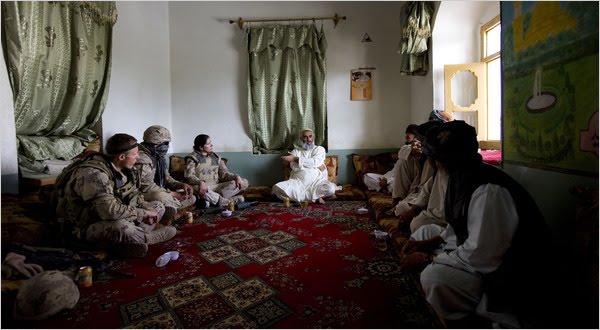
What's wrong with this photo?


Aside from the obvious - winning confidence and trust whilst still wearing ballistic protection and sporting the latest automatic weapon might have the opposite desired outcome - just take a closer look at these bozos (the ones in camouflage, not the local fellows). They are obviously guests. Now look at the local fellows: You will note that the local fellows have bare feet. This is customary in Muslim communities; entering someone's home (or the mosque) one takes his/her shoes off. We are talking entry-level cultural sensitivity here; even this very elementary of cross-cultural behaviours, the US-NATO cannot manage to get right.

And I am quite certain that there are rules and SOPs about wearing your ballistic vest at all times, keeping your weapon by your side, and never taking your shoes off; but, are these troops here to win a war or comply with procedures?

Another doozie is the following quote from Colonel Randy George (of the Fourth Brigade Combat Team, Fourth Infantry Division):

“We’re not worried about corruption in itself, but we are worried about governance.”

I can't decide if the tautology and gross misapprehension embodied in this statement is deliciously amusing or vaguely terrifying. Perhaps it's both!

Monday, April 19, 2010

Boss-i-cide: Killing Your Way Out of Chaos (2)

Last week, I shared a provocative piece that appeared in the New York Times on a certain Ugandan former-combatant-on-again-combatant (aka EX-ex-combatant) deployed with Ugandan and US soldiers to hunt down rebels in the wilds of Central Africa.

Boss-i-cide is actually more common than most people think. Reminds me of advice that an old boss once gave me:

"Only a truly loyal employee would kill himself for the good of his boss. Your boss will fondly remember you for at least a week, and you might even win employee of the month. Which is totally worth it."

This quote may be slightly off-piste, but killing yourself is a really strong possibility when you are 800 miles from home, armed to the teeth, and trying to catch jungle guerrillas on foot. If it's not for loyalty to the boss, then perhaps its out of hatred for the boss!

Maybe this whole business of turning the ex-combatant on his erstwhile rebel comrades has been misunderstood! The real buzz for these intrepid former-rebels is the opportunity of knocking off their boss. Admittedly this example is quite elaborate (i.e. helicopter gunships and so forth), but the principle is the same.

Gets you thinking doesn't it...

Friday, April 16, 2010

Why Are Cars Still Being Manufactured With Cassete Radios?

Why are cars still being manufactured with cassete radios?

Is it an admission that this simple old technology works? In spite of our iPODs with those infernal little radio transmitter thingies (that disconnect at the slightest bump). The cassette was simple, robust, and lasted. Yet no-one uses them anymore, and car manufacturers still install it as standard!

There's also the possibility that, like so many things that we buy, it's an add-on to validate our need for a certain amenity that is expected as of right. Even if it is useless. Sort of like showers in Africa, when there is no running water!

Which bring me to the incorrigibility of Hamid Karzai. Karzai is the political equivalent of a cassette radio.

He leads a government that cannot maintain its writ or territorial integrity, fails to provide social services without outside help, and he shamelessly depends almost entirely on outside help for everything. The pride of Afghanistan is an outstretched hand, palm-side up.

What he has that no cassette radio has is the gall to bite the hands that continue feeding him!
Afghanistan is a concept. An intoxicating concept of what should be, a dizzying liaison amidst a mess of destruction and misery.

The old cliche, 'who is the fool, the fool or the fool who follows him?' aptly describes Bush-then-Obama's excursions in Afghanistan.

Following Karzai down a rabbit hole and through the looking-glass. We have fancy names for it now - reconciliation, governance, counter-insurgency or 'COIN', and many colourful turns of phrase that omit the bare fact that Karzai and his government are a chimera.

Bush had his weekly phone confab with Karzai, the world's most powerful man indulging his sense of adventure, keeping it close-by, stroking it like a pet python. Then Obama enters the frame; no more phone convos - time for Tough Love.. Deploy 47,000 more troops, nab a Nobel, send in the best and brightest (Holbrooke, Farrow). Time for tough love is it?

Karzai is the dubious leader of an impecunious state that cannot pay its bills, is forever embroiled in bloodshed, and until recently had strategic importance until even al Qaida decided enough was enough. Farcical elections, a poppy-fuelled civil war, rampant fraud, and this mad hatter is still the doyen of international largesse. You either love him or hate him depending on whether you're Republican or Democrat. Whichever is the case, you still pick up the tab. While, I might add, the folks back home are getting retrenched and booted out of emergency!

Even when the enemy ups sticks and leaves the melee (al Qaida), US/NATO decides it may as well keep fighting the Taliban. Participating in a civil war in order to win hearts and minds is the new strategy, 'COIN' it's called (mind you, Karzai's understanding of 'coin' may be little less violent and a lot more mercantilist).

Karzai is an old warlord that no-one really needs, but he came with the purchase, so we keep thinking we need him. Like that cassette radio. He is utterly useless, except for those old tapes you insist on playing, hoping that the right time will come around when someone wants to listen to Neil Diamond. He belongs to the past, yet we keep him in there for the sake of verisimultude.

Again, why are cars still being manufactured with cassete radios?

Saturday, April 10, 2010

Killing Your Way Out of Chaos

My commiserations to those poor sods waiting for spiteful Double Negative commentary, here is a paltry belated offering from the New York Times :

http://mobile.nytimes.com/article?a=576859&f=110

Such are the dim bulbs calling the shots on reconciliation/reintegration and counterinsurgency in places like Afghanistan and Uganda; negatively reinforcing the trauma and violent tendencies of the very people who have taken the crucial step of walking away from the fight. By plunging them back into chaos, the strategic effect of such approaches is akin to a dog chasing its own tail. The utter confusion and violence of the fixers' will always have the unintended consequence of precipitating increasingly complex permutations of conflict and fracturing of civil society.

The message this sends out to all other active and demobilized combatants is that you can never get out, never get ahead.

As if crimson hues of the butcher's apron was the new black, Human Rights Watch reckons foreign troops and former rebels traipsing through the jungle in hot pusuit is a good thing.

Depressing stuff.